Stopping Driveway Blocking: Why Signs Fail and What Physically Works
Every property manager, small business owner and homeowner eventually runs the same experiment. Someone parks across the access. A polite note is left. Then a sign goes up. Then a traffic cone appears. Then a bigger sign. And the driver keeps parking there, because none of those things prevent anything — they only inform someone who has already demonstrated that they do not care what the sign says.
The conclusion homeowners reach after cycling through the soft options is blunt and correct: the only thing that stops people is a physical barrier. This article is about choosing the right physical barrier — because "bollard" covers products that differ by two orders of magnitude in price, installation effort and stopping force, and picking the wrong end of that range wastes either money or the entire investment.
1. Define What You Are Actually Preventing
Before comparing products, be honest about the threat model. These four situations look similar and need different hardware.
- Accidental encroachment. Delivery drivers, visitors and customers who genuinely do not realise the boundary. A visual cue solves this — cheaply and permanently.
- Opportunistic parking. People who know it is your access but assume nobody will mind for twenty minutes. This needs an obstruction, not a warning.
- Repeat, deliberate blocking. The same vehicle, repeatedly, after being asked to stop. This needs a lockable barrier that only you can lower.
- Security threat. Vehicle theft, ram-raid, or protecting a shopfront. This is a different product class entirely — rated security bollards set in a concrete foundation, not anything discussed here.
Most people who ask for "a bollard" are in category two or three. Most people who buy one buy a category-one product, and then report that it did not work.
2. The Four Product Classes, Compared Honestly
| Class | Stops a determined driver? | Install effort | Relative cost | Best use |
|---|---|---|---|---|
| Delineator post (weighted base) | No — advisory only | None — free-standing | Lowest | Marking a boundary, temporary lane separation |
| Collapsible flexible bollard | No — bends and recovers | Low — base fixing | Low | Permanent visual boundary that survives being driven over |
| Water-filled barrier | Partly — mass deters, does not lock | Low — fill on site | Low per metre | Perimeter for works and events, long runs |
| Lockable / automatic barrier lock | Yes for casual parking | Medium — anchored to slab | Highest per unit | A specific bay or a single access point you control |
Note the pattern in the first column. Only the last row prevents a person who has decided to park there. Everything above it changes behaviour by making the boundary obvious — which genuinely solves the accidental-encroachment case and genuinely does not solve the deliberate one.
3. Flexible Bollards: The Most Misunderstood Product
Buyers often reject flexible bollards on the grounds that "a car can just drive over it". That is precisely the design intent, and in the right application it is a feature rather than a defect.
A flexible HDPE bollard exists to mark a line that vehicles should not cross while accepting that occasionally one will. When that happens, a rigid post transfers the impact into the vehicle, into the post, and into the anchor — producing a damaged car, a snapped post and a torn-up slab. A flexible post collapses, the vehicle passes, and the post springs back to full height. Nothing is destroyed and nothing needs replacing.
That makes them the correct choice for lane separation, car park aisles, drive-through routes, forecourt boundaries and anywhere snow ploughs operate. Two specification details matter more than price:
- Height tier. Short posts around 50 cm read as ground markers; 80 cm is the general parking-lot height; 120 cm is what you need if the post must be visible over a parked car or from a truck cab.
- Reflective grade. "Reflective" is not a specification. Prismatic HIP film at RA2 grade returns dramatically more light at night than budget engineering-grade sheeting, and night-time visibility is the entire job in most installations.
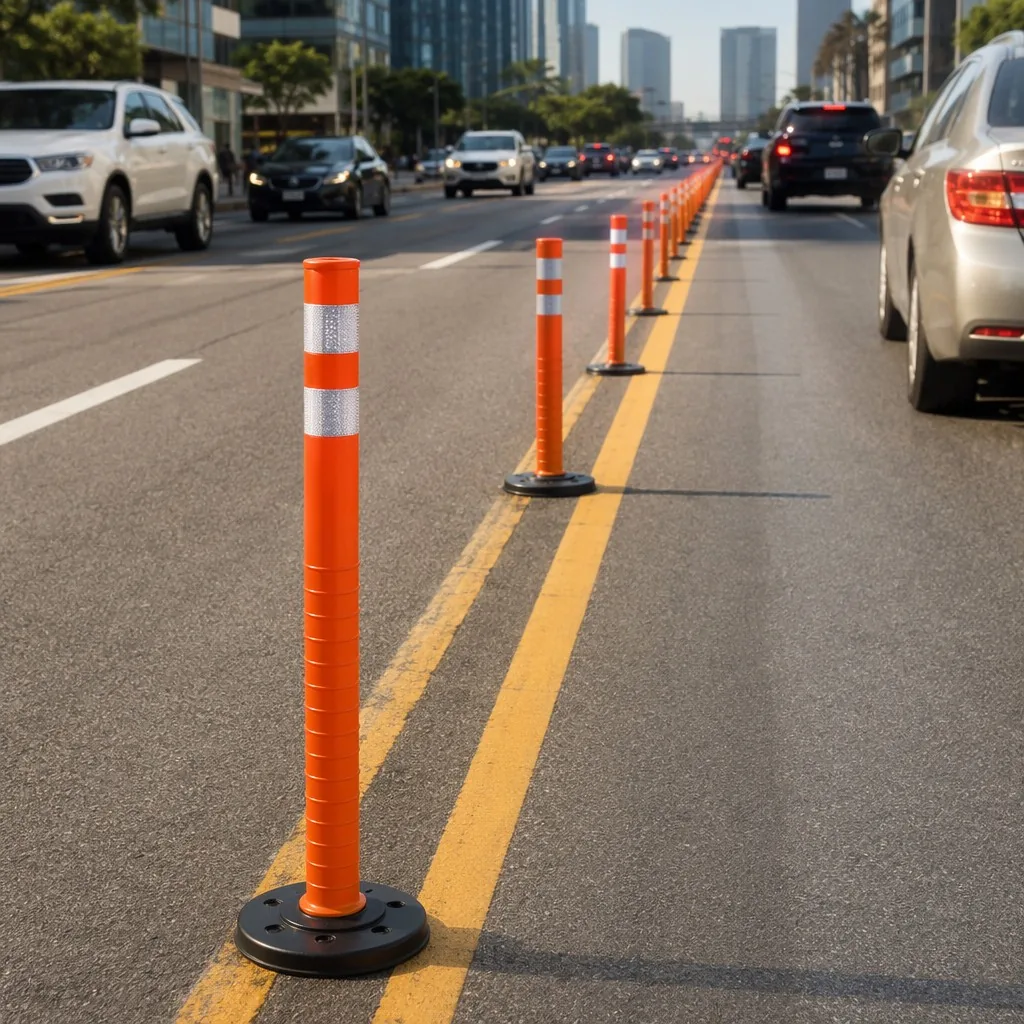
Collapsible HDPE Traffic Bollard (50/80/120 cm)
Springs back after a full vehicle roll-over · 3 height tiers for parking, driveway or lane use · 2 × HIP prismatic reflective bands (RA2) · 5 kg weighted round base · no sharp edges.
View specifications & request a quote →4. When You Need a Lock, Not a Marker
For a single reserved bay — an allocated space in a shared lot, an EV charging stall, a loading position that must stay clear — the product that actually works is a barrier lock: a hinged steel arm anchored to the slab that stands up when locked and folds flat when released.
The reason this class succeeds where bollards and signage fail is that it removes the negotiation. There is nothing to argue about with a driver who wanted the space; the space is physically not available, and the only person who can make it available is the holder of the remote or key.
Three practical selection points:
- Power. A solar unit avoids trenching a cable across a finished surface, which is frequently the largest hidden cost of a mains-powered installation.
- Ingress protection. An outdoor unit lives in rain, snow, dust and washdown. Confirm an IP rating rather than "weatherproof".
- Folded height. The unit must fold flat enough that a car can park over it without contact, and it must be visible enough when raised that nobody reverses into it at night. A safety-striped upper bar is not decoration.
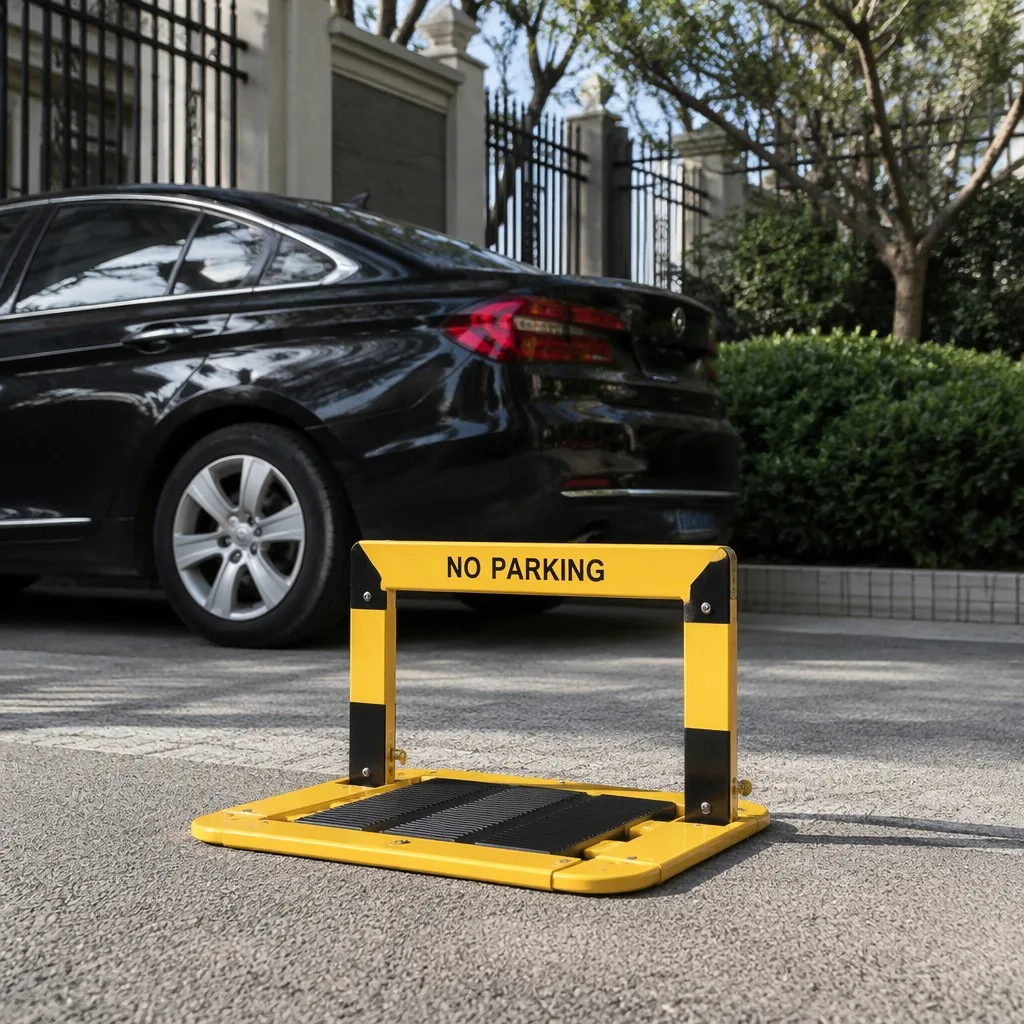
Automatic Remote-Controlled Parking Space Barrier Lock
Solar powered — no wiring or trenching · wireless remote with 30 m range · rises 60 cm when locked, folds flat when released · yellow-and-black striped bar · IP54 rated for outdoor use.
View specifications & request a quote →5. Temporary and Event Access Control
Not every access problem is permanent. Contractors closing a lane, event organisers defining a perimeter, and facilities teams sectioning off a resurfacing area all need something that arrives light, becomes heavy on site, and leaves again.
Water-filled barriers exist for exactly that duty cycle. Empty, a unit is light enough for one person to carry and stacks efficiently for freight; filled from a hose on site, the same unit is heavy enough that it will not be shoved aside casually. Interlocking ends let you build a continuous perimeter of any length, and at the end of the job you pull the drain plugs and the barrier becomes freight-friendly again.
The trap is treating them as a security product. A water-filled plastic barrier is a delineation and deterrence device; it is not a vehicle-arresting structure, and a determined driver can displace one. Specify them where the objective is "clearly define this perimeter and discourage entry", not "prevent entry".
Where the requirement is purely visual guidance — a taper into a coned lane, a temporary boundary across a forecourt, separating a queue from a driving route — a weighted-base T-top delineator post is faster to deploy and easier to store than either barriers or bollards, because there is nothing to fix and nothing to fill.
6. A Layered Approach Beats One Expensive Purchase
Most sites do not need one product. They need a sequence that escalates along the route:
- Layer 1 — Inform. Signage and reflective delineators at the approach, so a compliant driver never reaches the boundary in the first place.
- Layer 2 — Define. Flexible bollards along the edge, making the boundary unambiguous and surviving the occasional contact without maintenance.
- Layer 3 — Prevent. A lockable barrier at the one point that must genuinely stay clear.
This is the same hierarchy that governs warehouse traffic planning, where physical separation always outranks administrative rules — we work through that logic in detail in our warehouse forklift lane safety guide. The principle transfers: controls that depend on someone choosing to comply will fail at the rate that people choose not to.
7. Installation Notes That Save a Second Visit
- [ ] Ownership and rights of way confirmed in writing before any fixing is drilled
- [ ] Substrate identified — asphalt and concrete take different anchors, as covered in our speed bump anchoring guide
- [ ] Underground services located before drilling anywhere near a boundary
- [ ] Swept path checked — can a delivery vehicle still turn in with the barrier installed?
- [ ] Emergency access preserved; fire and ambulance routes must stay usable
- [ ] Night visibility verified on site, not from the datasheet
- [ ] Bollard height chosen against the tallest object it must be seen over
- [ ] Spare units held — a gap in a boundary invites exactly the behaviour you are stopping
8. What This Costs in Practice
The reason a barrier lock costs an order of magnitude more per unit than a flexible bollard is that it contains a mechanism, a power source and a lock, and it has to survive outdoors while being the only thing standing between a driver and the space they want. The reason a flexible bollard is cheap is that it does not have to survive anything — it yields.
Buy according to which of those two jobs you actually have. A row of flexible bollards protecting a boundary nobody deliberately violates is money well spent. A single flexible bollard defending a space from a repeat offender is money thrown away, and buying three of them does not change the outcome.
Frequently Asked Questions
What actually stops people parking across a driveway?
A physical barrier. Signage, cones and paint are advisory and work only on drivers who were already willing to comply. Anyone prepared to ignore a sign will also ignore a cone. If the behaviour has repeated, the practical answer is a lockable or removable bollard set in an anchored ground socket.
Do I need permission to install a bollard?
It depends on ownership and rights of way. On land you own outright, a bollard is usually straightforward. On a shared access, a private road, or anywhere a neighbour holds a right of way, installing a barrier typically requires the agreement of everyone with rights over the access. Check the deeds and local rules before drilling anything.
What is the difference between a collapsible bollard and a fixed bollard?
A collapsible flexible bollard is a visual and psychological barrier: it bends or flattens under a vehicle and springs back, so it marks a boundary without damaging the car or itself. A fixed or lockable steel bollard is a physical barrier intended to actually arrest a vehicle. Choose flexible for guidance and traffic separation, rigid for security.
Specify Once, With the Right Class
Tell us three things and we can quote the right product rather than the cheapest one: whether the access is being crossed accidentally or deliberately, whether the ground is asphalt or concrete, and whether the barrier must be operable by one person from a vehicle. Tiantai Minjun manufactures flexible bollards, delineators, barrier locks and water-filled barriers in Tiantai County, Zhejiang, and ships factory-direct.