Forklift Blind Corners: Mirrors, Sightlines and What Actually Works
Every warehouse has one. The corner where a racking run meets a cross aisle, where a driver cannot see a pedestrian and a pedestrian cannot see 2.5 tonnes of counterbalance truck until both are already in the intersection. It is the single most predictable collision point in the building, and it is usually treated with one undersized mirror bolted wherever the ladder happened to reach.
This is a practical guide to fixing it properly: how to work out what the driver can actually see, how to size and aim a mirror so it earns its place, and what to do when a mirror is not enough.
Why Blind Corners Are Worse Than They Look
Three things stack up at an intersection, and each one is individually survivable. Together they are not.
- The load blocks the driver. A raised or bulky load on the forks removes a large part of the forward field of view. Standard practice is to travel in reverse when the load obstructs vision, which solves one problem and creates another: the driver is now looking backwards into the direction of travel and forwards is unattended.
- The mast blocks the driver even without a load. The upright channels, chains and hydraulic lines create fixed vertical blind stripes. A pedestrian standing in one of those stripes at the wrong moment is genuinely invisible, not merely overlooked.
- Nobody hears anything. Electric trucks are quiet by design, the ambient noise floor in a busy warehouse is high, and hearing protection is often mandatory. The audible warning that would work in a quiet space does not arrive in time in a loud one.
Step 1: Map the Sightline Before You Buy Anything
Do this before selecting hardware. It takes fifteen minutes and it changes what you order.
- Sit in the truck. Not stand next to it. Seated eye height on most counterbalance trucks is far lower than a standing adult, and the blind zone from that position is dramatically larger. Every judgement made from a standing position overestimates what the driver can see.
- Have someone walk the crossing aisle at normal pace while you watch from the approach. Mark on the floor the exact point at which they become visible.
- Measure from that mark to the intersection. That distance is your real warning margin. If it is less than the truck's stopping distance at its actual travel speed, the corner is unsafe as configured.
- Repeat from the other approach. Corners are rarely symmetrical. One direction is usually much worse, and that is the direction your mirror has to serve.
- Repeat with a loaded truck. The empty-truck sightline is the optimistic case and it is not the case you are designing for.
Step 2: Size the Mirror by Distance, Not by Corner
The most common purchasing mistake in this category is buying by price or by what fits the bracket. Mirror diameter should be driven by the observation distance measured in step 1.
| Mirror diameter | Practical observation distance | Typical placement |
|---|---|---|
| 60 cm | Short — tight indoor corners | Narrow pick aisles, doorway blind spots |
| 80 cm | Around 5 metres | Indoor aisle intersections, parking structures |
| 100 cm | Around 15 metres | Yard corners, dock approaches, long cross aisles |
Observation distances quoted are the working figures for our own PC mirror range and are consistent with general convex mirror sizing practice. Treat them as a starting point and verify on site with the walk test above.
The failure mode of an undersized mirror is subtle and worth naming: the driver can see that something is there, but cannot resolve what. A person, a pallet jack and a stack of empty pallets all read as a dark shape at the edge of a small convex lens. Drivers learn quickly that the mirror does not tell them anything actionable, and then they stop consulting it. An undersized mirror is worse than no mirror because it consumes the attention budget without returning information.
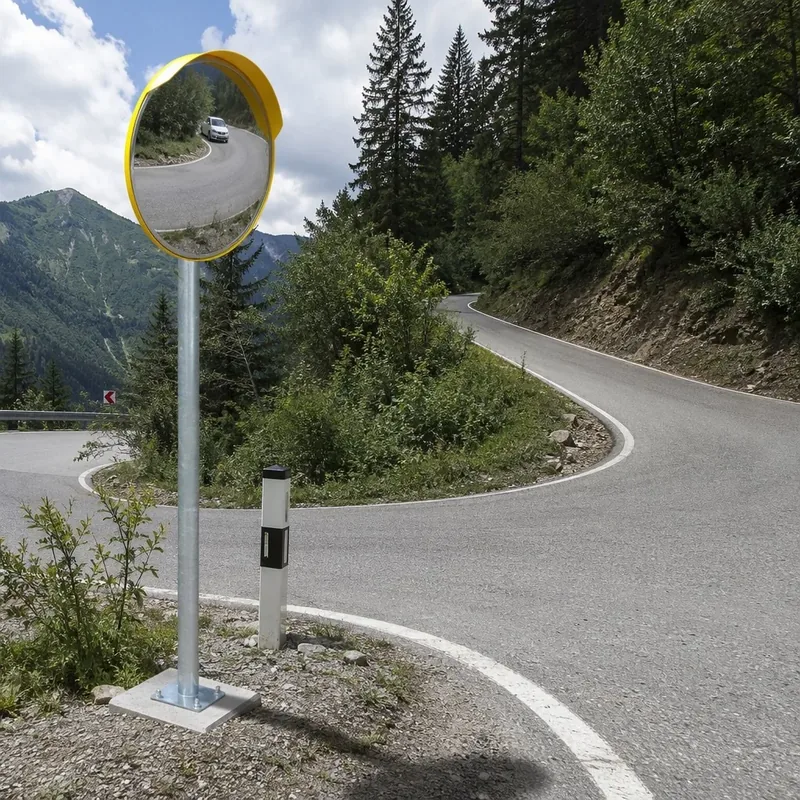
100 cm Outdoor Convex Road Mirror (Pole-Mounted)
Covers a 15-metre observation distance · PC shatterproof lens · weather-shield back cover with drainage lip · 2-metre steel pole with concrete base plate, no digging required · arrives assembled.
View specifications & request a quote →Step 3: Mount It Where It Warns, Not Where It Confirms
Two placement errors account for most useless mirror installations.
Mounting on the near corner. A mirror on the corner the driver is approaching only becomes readable once the truck is level with it — by which point the driver is in the intersection and the mirror is confirming a collision rather than preventing one. Mount diagonally opposite, on the far side, so the reflection is available during the approach.
Defaulting to 45 degrees. The 45-degree rule circulates widely and it is only correct for a symmetrical crossing where both approaches matter equally. Real intersections are lopsided: one aisle carries pedestrians, the other carries trucks; one sightline is 4 metres and the other is 12. The correct angle bisects the two sightlines you actually need, and it must be verified from the seated driver position with someone standing at the far limit of the crossing aisle. A universal ball-joint mount matters here precisely because the right angle is rarely the obvious one.
Practical mounting height indoors is roughly 2.5 to 3 metres: high enough to clear a raised load and stacked stock, low enough that the viewing angle is not so steep that the lens shows mostly floor. Outdoors on a pole, the same logic applies relative to vehicle roof height.
The maintenance point that gets skipped
A convex mirror in a warehouse accumulates dust, forklift exhaust film and cold-store condensation. A filmed-over mirror does not announce that it has stopped working — it simply becomes progressively less useful until nobody consults it. Put mirror cleaning on the same schedule as aisle sweeping, and check the aim at the same time, because mirrors get knocked out of alignment by pallets and by ladders far more often than anyone reports.
Step 4: Accept That the Mirror Is Only the Warning Layer
A mirror tells a driver something. It cannot make them slow down, and it cannot stop a truck that is already committed. Corners that keep producing incidents after a good mirror has been installed need a physical layer as well.
| Layer | What it does | What it cannot do |
|---|---|---|
| Convex mirror | Reveals the conflict early enough to react | Enforce anything; useless if unclean or unaimed |
| Floor marking | Defines where pedestrians belong; sets expectation | Stop anyone physically |
| Delineator posts | Channels traffic away from the corner apex, forces a wider turn that opens the sightline | Withstand a deliberate impact |
| Corner guards | Protects the structure and marks the hazard in low light | Prevent the collision itself |
| Speed control at the intersection | Buys back reaction distance — the only measure that changes the physics | Work without supervision and enforcement |
The delineator row deserves attention because it is the cheapest genuine sightline improvement available. Pushing the traffic path 600 mm away from the corner apex with a line of flexible posts widens the turn radius, which opens the driver's view down the crossing aisle earlier. Flexible posts matter here: a rigid bollard at a corner that gets clipped weekly becomes a maintenance item and eventually a projectile. A T-top delineator post with a flexible PU tube that bounces back after a 90° bend, on a weighted rubber base, absorbs the clipping without being replaced.
Step 5: Guard the Strike Zone on the Column
Corner columns take hits. That is not a hypothetical; the paint scarring on the corner in your own building is the evidence. Guarding serves two purposes at once, and most sites only think about the first.
- Structural protection. Repeated mast and load-corner strikes on an unprotected column are a cumulative problem, and racking uprights in particular lose capacity once deformed.
- Visual conspicuity. This is the underrated one. A reflective corner guard makes the corner itself legible in low light, which is exactly the condition — early shift, poorly lit cross aisle, cold store — where blind-corner incidents concentrate.
Cover the actual strike zone, roughly the first 600 to 1200 mm above floor level where masts, forks and load corners make contact. Guarding that starts at knee height and stops below the fork carriage protects the wrong band.
Two material choices, for genuinely different jobs:
- Soft EVA foam where the concern is vehicle and product damage rather than structural. It absorbs impact without marking paintwork, uses peel-and-stick adhesive so no drilling is needed, and the adhesive on our reflective EVA corner guard is specified down to −20 °C, which matters in cold storage where ordinary adhesives release. Yellow-and-black diagonal stripes with retroreflective glow. From $1.99, MOQ 100 pcs.
- Rigid PVC where you want a permanent installation that will not compress or deform over time. Our fluorescent yellow PVC corner guard screw-mounts through four 6 mm holes, uses HIP prismatic reflective on a fluorescent base so it reads in low light, and is chemical and oil resistant for warehouse and cold-storage use. From $2.49, MOQ 100 pcs.
Both wrap a 90° corner in a single piece, which matters more than it sounds: two flat strips butted at a corner leave the apex — the exact point that gets struck — unprotected.
A Corner Audit You Can Run This Week
No budget required for the audit itself. Work through every intersection in the building:
- Seated in a loaded truck, at what distance does a walking pedestrian become visible? Write the number down.
- Is that distance greater than the stopping distance at the speed trucks actually travel there, not the posted limit?
- Is there a mirror? Is it on the far side or the near side?
- Can you identify a person versus a pallet in it from the approach, or only detect that something is present?
- Is it clean? When was it last aimed?
- Does the column show impact scarring? Is the scarred band actually guarded?
- Is there anything physical channelling traffic away from the apex, or does the path hug the corner?
Corners failing items 1 and 2 need engineering attention, not another sign. Corners failing only items 3 to 7 can usually be fixed for the cost of a mirror, a few delineator posts and some guarding.
Frequently Asked Questions
What size convex mirror do I need for a warehouse blind corner?
Size by the longest sightline the mirror must cover, not by the size of the corner. As a working rule an 80 cm mirror serves roughly 5 metres of observation distance and a 100 cm mirror roughly 15 metres. If a driver cannot resolve whether the shape in the mirror is a pedestrian or a pallet, the mirror is undersized whatever the box said.
Where should a convex mirror be mounted at a blind intersection?
On the far side of the intersection, diagonally opposite the approach, at roughly 2.5 to 3 metres. Mounting on the near corner is the most common error, because the driver has already entered the conflict zone by the time the mirror becomes readable.
Should a warehouse mirror be mounted at 45 degrees?
No. That rule of thumb only holds for a symmetrical crossing with equally busy, equally long approaches. The correct angle bisects the two sightlines you actually need to cover, verified from a seated driver eye position rather than a standing installer's.
Do convex mirrors actually reduce forklift accidents?
They help, but they are a warning device, not a barrier. A mirror only works if the driver looks at it, if it is clean, if it is aimed correctly, and if the lighting is adequate. Sites relying on mirrors alone tend to keep having incidents; sites combining mirrors with physical separation, floor marking and enforced speed control at intersections see them stop.
Glass or polycarbonate mirror for a warehouse?
Polycarbonate anywhere a forklift can reach. A glass mirror struck by a mast or load throws shards across the traffic aisle, turning one incident into a cleanup and a tyre-damage problem. Polycarbonate deforms or cracks without shattering. Glass offers marginally better optical clarity, worth having only where impact is genuinely impossible.
How high should a corner guard be on a warehouse column?
Cover the strike zone — for most counterbalance trucks the first 600 to 1200 mm above the floor, where mast, forks and load corners make contact. Guarding that starts at knee height and stops below the fork carriage leaves the band that actually gets hit unprotected.
Related Reading
- Warehouse forklift lane safety: delineators, mirrors and aisle layout — the aisle-level view of the same problem.
- Standard loading dock height vs box truck bed height — the other predictable collision point in most facilities.
- Dock bumpers: rubber vs laminated vs steel-faced — impact protection where trucks meet the building.
Fixing a blind corner in your facility?
See the 100 cm convex road mirror →
Send us your aisle dimensions and the sightline distance you measured. We will tell you the mirror diameter that fits — and say so if a mirror is not the right answer for that corner.
→ WhatsApp Alice for Quote