Wheel Stops and Parking Lot Liability: Why Crumbling Concrete Blocks Cost More Than They Save
Wheel stops are cheap but legally consequential: they sit in the pedestrian path, take repeated vehicle impacts and become dangerous when anchors or reinforcement are exposed. Rubber avoids concrete spalling, but the correct material, anchor and inspection interval depend on the pavement and vehicle class.
A deteriorated stop can puncture a bumper or trip a pedestrian, turning a minor parking-lot component into a documented maintenance claim. This guide compares the failure modes and gives a purchase specification that avoids them.
Property managers rarely think about wheel stops until a customer sends a photograph of a punctured bumper or a torn trouser leg. By then the conversation has already moved from "which product should we buy" to "when did you last inspect the lot". This guide is written for the people who make that specification decision: facility managers, paving contractors, municipal fleet buyers and distributors. It covers what the 2010 ADA Standards actually say (which is not what most vendors claim), why concrete blocks fail the way they do, how anchoring behaves differently on asphalt and concrete, and how to write a purchase specification that will not come back to you in three winters.
1. The Failure Mode Nobody Budgets For
Concrete parking blocks do not fail gracefully. They are cast around steel reinforcement and pinned to the pavement with steel rebar driven through pre-formed holes. Two things then happen over time. Water enters through the pin holes and the surface pores; in freeze-thaw climates it expands and spalls the concrete away from the top face. Simultaneously, de-icing chloride accelerates corrosion of the reinforcement, which expands as it rusts and cracks the block from the inside.
The result is a block whose top surface has eroded by an inch or two while the steel pin stays exactly where it was — now protruding above the concrete. Public complaints about this are remarkably consistent. Drivers describe backing over a stop where "the only one with one steel rebar sticking out the top" protruded roughly two inches, and pedestrians describe catching a foot on a pin that had gone dark with weathering and was invisible against the grey concrete beneath it.
That colour change matters more than it sounds. Freshly cut rebar is bright and catches the eye. Weathered rebar, stained by rust and by chloride from the surrounding concrete, reads as part of the block. A pedestrian's gait is calibrated by their eyes several steps in advance; if the eye does not register the pin, the foot does not clear it.
2. What the ADA Actually Requires
Vendors frequently advertise wheel stops as "ADA required". They are not. The 2010 ADA Standards for Accessible Design do not contain a clause mandating a wheel stop in an accessible stall.
What Section 502 does require is that parking spaces and access aisles be designed so that cars and vans, when parked, cannot obstruct the required clear width of the adjacent accessible route. That is a performance requirement, not a product requirement — and the reason it bites is vehicle overhang. A front bumper routinely projects 18 to 30 inches past the stall line. If your accessible route is a 36-inch sidewalk running along the head of the stalls, a single pickup truck can reduce it to nothing.
A wheel stop is one of the accepted engineering answers to that problem, which is why the Standards' advisory material describes wheel stops as an effective way to prevent vehicle overhangs from reducing the clear width of accessible routes. The other answers are to deepen the stall so the overhang lands on paint rather than on the route, or to widen the walkway. Whichever you choose, note the two dimensions that are mandatory: an accessible car stall is a minimum of 96 inches wide, and the access aisle beside it is a minimum of 60 inches wide.
3. Concrete vs Rubber vs Plastic: The Honest Comparison
Each material genuinely wins somewhere. Anyone who tells you one material is correct in all cases is selling that material.
| Criterion | Concrete block | Recycled rubber | Recycled plastic |
|---|---|---|---|
| Typical weight (6 ft unit) | ~150–250 lb | ~16–30 lb class | Lightest of the three |
| Installation crew | Machinery or 2+ people | One person, hammer drill | One person, hammer drill |
| Service life if undisturbed | Longest — 15–20 yr claims are common | Long; does not spall | Shortest under UV and cold |
| Failure mode | Spalling → exposed steel | Surface wear, colour fade | Cracking, brittleness in cold |
| Damage to vehicles on contact | Rigid — transmits full impact | Compliant — absorbs lateral load | Moderate |
| Best fit | Permanent municipal lots, no layout change | Commercial lots, freeze-thaw, frequent restriping | Low-traffic, mild-climate, tight budget |
Two entries in that table drive most decisions. The first is weight. The gap between a 150–250 lb concrete block and a rubber unit in the 16–30 lb class is the difference between hiring equipment and sending one worker with a drill. On a 200-stall lot that difference dominates the installed cost, and it reappears every time the lot is restriped or re-laid.
The second is the failure mode row. Critics of rubber and plastic are right that reflective markings fade and that a faded, shifted stop is itself a hazard — but a faded stripe is a visibility problem you fix by replacing a 20 lb part. Spalled concrete is a puncture-and-trip problem you fix by breaking out 200 lb of masonry. Both need maintenance; they do not need the same maintenance budget or produce the same claim.
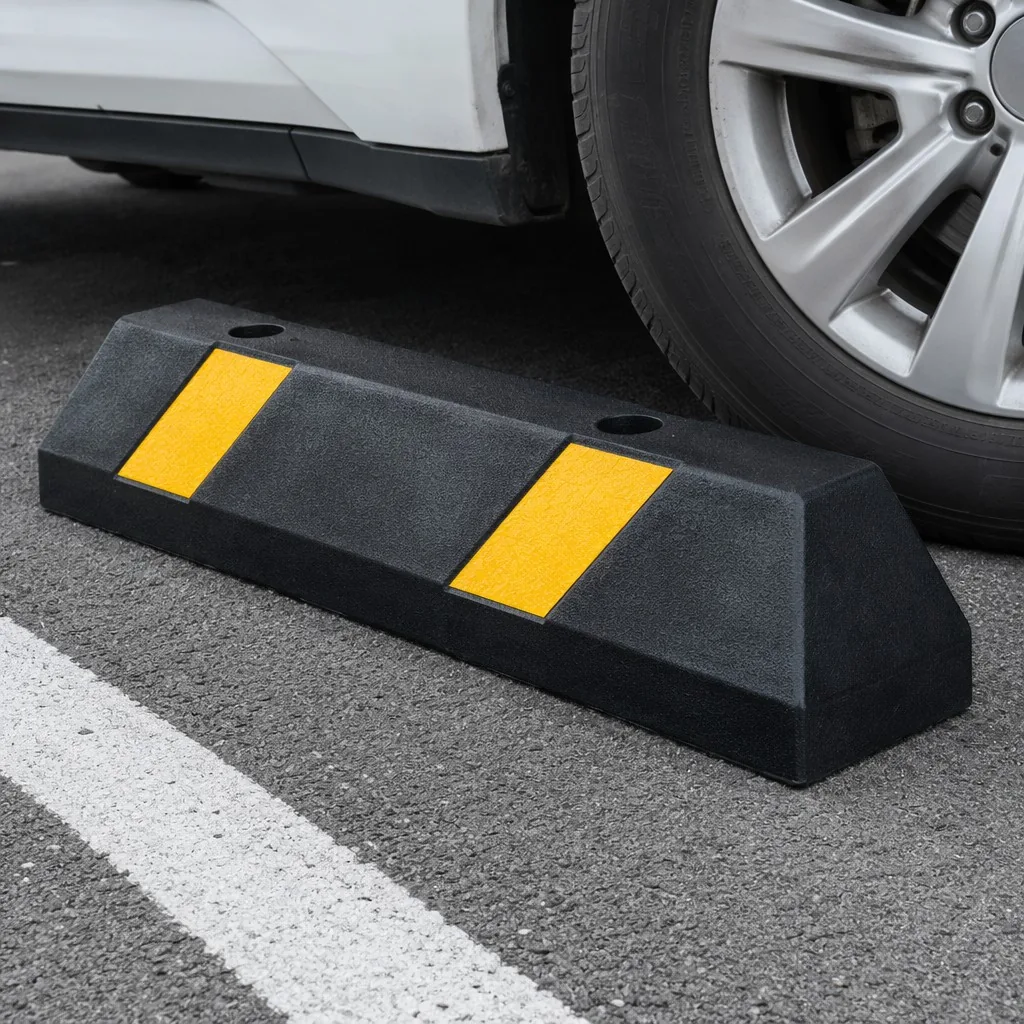
600mm Rubber Wheel Stopper (2-Hole Anchor)
Molded SBR/EPDM body — no laminated seams to crack · two 15 mm countersunk anchor holes so bolt heads sit flush · yellow retro-reflective stripes (RA1) · rated −40 °C to +80 °C.
View specifications & request a quote →4. Anchoring: The Part That Actually Decides Longevity
A wheel stop is only as good as its grip on the pavement, and the two common substrates behave nothing alike.
On concrete
Concrete is the friendly case. A drilled hole plus a mechanical expansion anchor or a chemically bonded pin develops very high pull-out resistance — figures in the range of 4,000 to 6,000 lb are cited for a 5/8-inch rebar pin set in an ASTM C928 epoxy. That is far more than any tyre will ever apply. On concrete, the anchor is essentially never the weak link; the stop material is.
On asphalt
Asphalt is a visco-elastic material. It creeps under sustained load and it softens in summer heat, which is exactly why the DIY consensus is blunt: asphalt is soft, so fixings intended for concrete will not behave the same way in it. A spike that felt solid in April can be walked loose by thermal cycling and repeated bumping by August. The practical rules:
- Use longer, larger-diameter spikes than you would in concrete — you are relying on friction along a long shaft, not on expansion against a rigid wall.
- Use more anchor points. This is the argument for three-hole rather than two-hole units on any long stop.
- Never install on hot, freshly laid asphalt. Let the mat cure or every anchor will loosen in the first season.
- Re-torque after the first summer. A ten-minute inspection round beats a claim.
- Prefer a compliant stop. A rubber unit flexes and absorbs lateral load rather than transmitting the whole impact into the anchor and the asphalt around it.
Countersinking matters here too. If bolt heads sit proud of the top surface, they become the same hazard as exposed rebar — with the added indignity that you installed it that way on purpose. Countersunk recesses that let the head sit flush are not a cosmetic detail; they are the difference between a maintained lot and a photographed one.
5. Sizing: Car Bays, Truck Bays and Freight Yards
Most lots need two sizes, not one.
- Standard car bays (600–1,200 mm units): a short stop placed centrally on the bay stops the wheel without becoming a continuous kerb across the walkway. It leaves a gap at each end for pedestrians and for a wheelchair to pass between bays — which is often more useful than the stop itself.
- Truck, bus and semi bays (1,800 mm / 72 in units): heavy vehicles have wide track widths, and a short stop can be straddled or hit at one end and levered out. A full-length unit engages both wheels and distributes the load across three or more anchors.
- Freight yards and heavy fleet: specify the static wheel load explicitly. Our 72-inch heavy-duty unit is rated for 15,000 kg static wheel load, which is the number to compare against, rather than a vague "heavy duty" label.
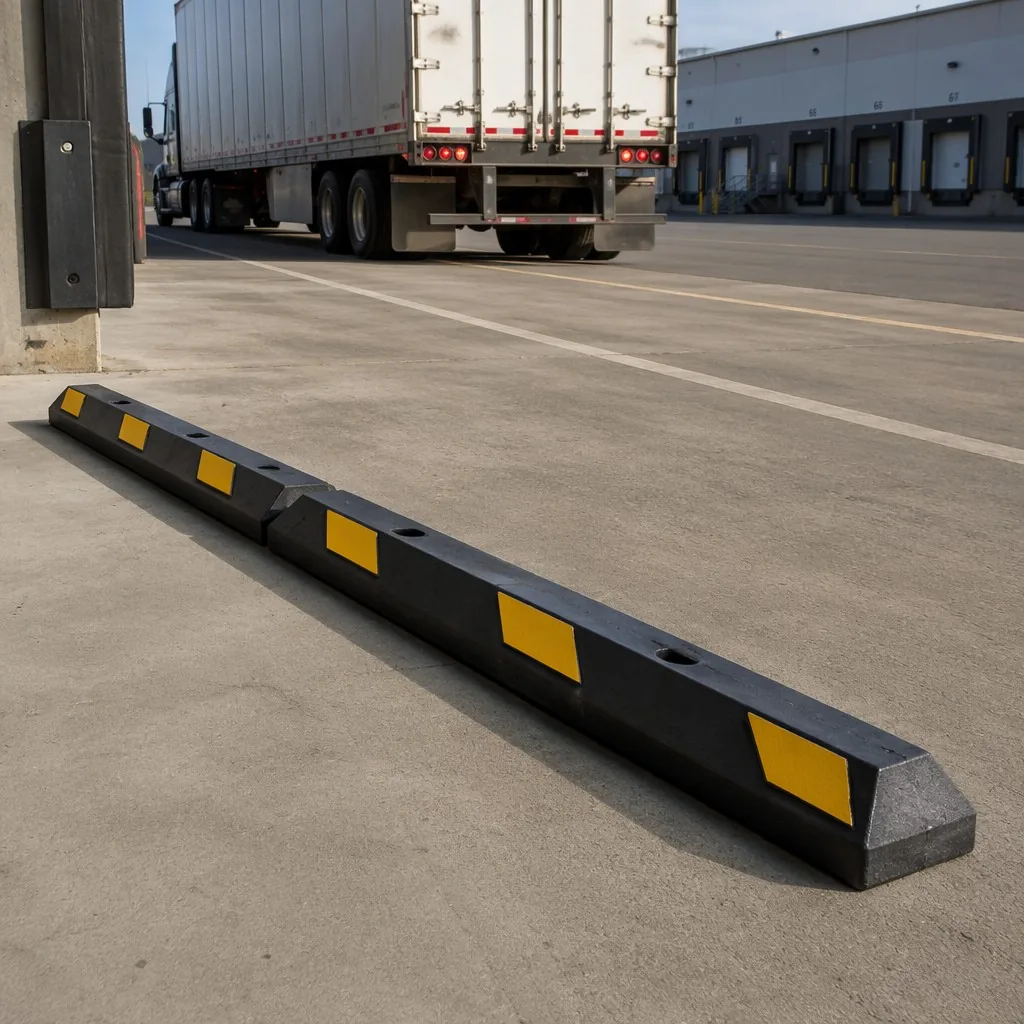
72" Heavy Duty Rubber Wheel Stopper
Full 1.8 m length for a semi-truck bay · molded, not extruded · 3 × Ø14 mm countersunk anchor holes · rated for 15,000 kg static wheel load.
View specifications & request a quote →One more caution from the field: a wheel stop is not a wheel chock. A stop is anchored to the ground and positions a parked vehicle; a wheel chock is a loose wedge placed against a tyre to prevent roll-away during loading or maintenance. Substituting one for the other is a recurring cause of incidents at loading docks, where the correct pairing is an anchored stop for parking geometry and a chock for the vehicle actually being loaded.
6. Purchase Specification Checklist
Copy this into your RFQ. Every line has cost you money somewhere if it was missing:
- [ ] Substrate stated: concrete or asphalt (this changes the anchor, not the stop)
- [ ] Anchor holes countersunk so bolt heads finish flush
- [ ] Number of anchor points appropriate to length — three for 1.8 m units
- [ ] Anchor hardware quoted as an add-on kit or explicitly excluded, never assumed
- [ ] Body molded rather than extruded/laminated — no bonded seams to delaminate
- [ ] Reflective stripe grade stated (RA1 or better), not just "reflective"
- [ ] Operating temperature range covers your winter low and summer surface high
- [ ] Length matched to vehicle class: short for cars, full 1.8 m for trucks
- [ ] Placement checked against the 96 in stall and 60 in access aisle minimums
- [ ] Replacement units held in stock — a missing stop is worse than a worn one
7. A Five-Minute Inspection Routine
Whatever you buy, the inspection is what keeps you out of a claim file. Walk the lot quarterly and look for four things: anchors protruding above the top face, units that have shifted out of the painted bay, stripes that no longer return light when you shine a phone torch at them from ten metres, and cracks running through an anchor hole. Any one of those is a replacement, not a repair. Photograph the round and date it — a documented inspection programme is worth more in a dispute than the stop itself.
Frequently Asked Questions
Does the ADA require wheel stops in accessible parking spaces?
No. The 2010 ADA Standards do not mandate wheel stops. Section 502 requires that parked cars and vans cannot obstruct the required clear width of an adjacent accessible route. Wheel stops are one accepted engineering method of achieving that, because a front bumper typically overhangs the stall line by 18 to 30 inches.
Why is exposed rebar on a concrete parking block a legal problem?
Concrete blocks are reinforced with steel and pinned with steel rebar. As the concrete spalls, the pin and the reinforcement become exposed, dark-coloured and hard to see. Property owners have a duty to inspect and maintain their lots, so a protruding pin that punctures a bumper or trips a pedestrian is a foreseeable hazard rather than an act of God.
How heavy is a rubber wheel stop compared with a concrete parking block?
Industry figures put a 6-foot concrete parking block in the region of 150 to 250 lb, while a 6-foot recycled rubber or plastic unit is roughly 16 to 30 lb. That is the difference between machinery plus a two-person crew and one installer with a hammer drill.
Specify It Once, Correctly
Wheel stops are a low-value, high-consequence line item. The money is not in the unit price; it is in the installation labour, the winter that spalls the concrete, and the single claim that arrives three years later with a photograph attached. Choosing a molded rubber unit with countersunk anchors and a stated temperature range removes the failure mode that generates most of those photographs.
Tiantai Minjun molds rubber wheel stops in Tiantai County, Zhejiang, and ships them factory-direct. If you tell us the substrate, the vehicle class and the destination climate, we will quote the right length and anchor pattern rather than the cheapest one.