3-Channel vs 5-Channel Cable Protectors: Which One Fits?
Choose the 3-channel model when the route is mainly used by pedestrians, wheelchairs, carts or light vehicles and every cable is 32 mm or smaller. Choose the 5-channel model when trucks, forklifts or construction equipment cross the run, when any cable is 33-42 mm, or when you need more than three separated services.
Quick Decision Table
| Decision point | CP-3CH: 3 channels | CP-5CH: 5 channels |
|---|---|---|
| Best use | Public walkways, trade shows, AV runs, carts | Roadways, warehouses, construction and film sets |
| Module size | 900 × 500 × 35 mm | 900 × 660 × 75 mm |
| Weight per module | About 11 kg | About 22 kg |
| Cable capacity | 3 channels, each up to 32 mm | 5 channels, each up to 42 mm |
| Static load rating | 10 tonnes per unit | 25 tonnes per unit |
| Accessibility role | Low-profile 35 mm body; request a measured side-slope drawing and verify the complete route | Roadway unit; accessible end ramps are optional and route compliance must be checked separately |
| Current MOQ | 20 pieces | 20 pieces |
| Current MOQ lead time | 18 days | 20 days |
Product figures above are taken from Tiantai Minjun model pages CP-3CH and CP-5CH, checked 16 September 2026. Confirm final specifications in the signed quotation.
Use the 3-Channel Protector for People-First Routes
The CP-3CH is 35 mm high and 500 mm wide. Its 35 mm body is lower than the 75 mm roadway model, and its 11 kg module weight makes it practical for crews that build and remove runs repeatedly. Do not infer a 1:12 slope from the product name: request a dimensioned side-profile drawing and measure the actual horizontal run. Three separated channels are usually enough for power, AV/data and a control or spare line.
Its 32 mm channel limit is the hard boundary. Do not count cables only: measure the outside diameter of the largest plug-free cable or bundled service. A bundle that looks small before taping can exceed the channel once connectors, joins or protective sleeves are included.
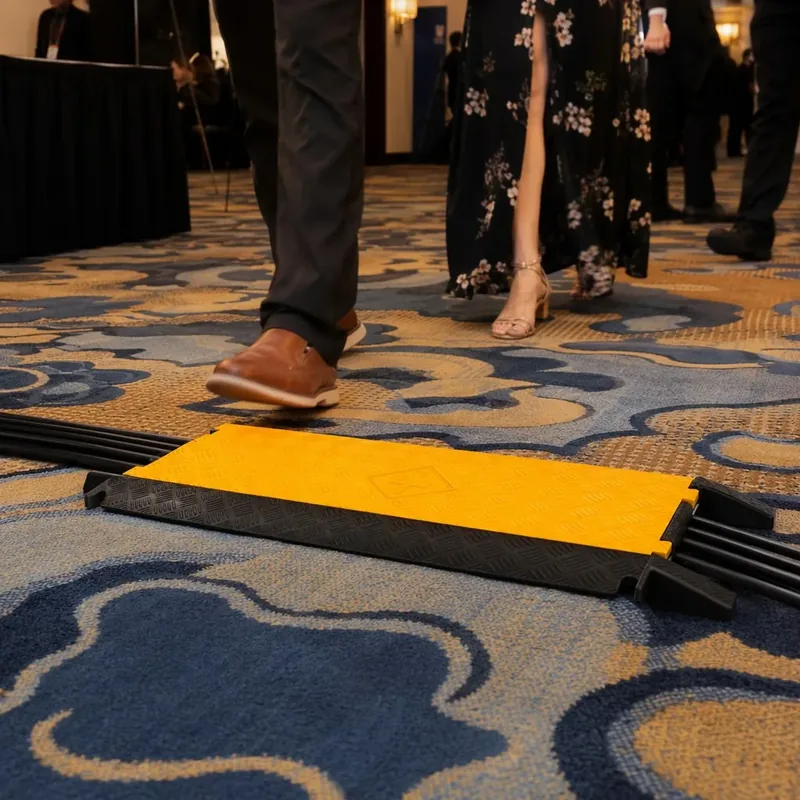
CP-3CH 3-Channel Cable Protector
900 × 500 × 35 mm · 3 × 32 mm channels · 10-ton static rating · about 11 kg.
View CP-3CH specifications →Use the 5-Channel Protector for Vehicles and Larger Services
The CP-5CH doubles the module weight to about 22 kg, increases the footprint to 900 × 660 mm and raises the static load rating to 25 tonnes. Its five 42 mm channels suit temporary power, control, data, audio and spare services where forklifts, cranes or freight vehicles cross the run.
That extra capacity comes with a 75 mm rise. Do not describe the standard roadway module alone as an accessible crossing. If pedestrians share the route, evaluate the complete installation against the applicable change-in-level, ramp slope, cross-slope and clear-width requirements.
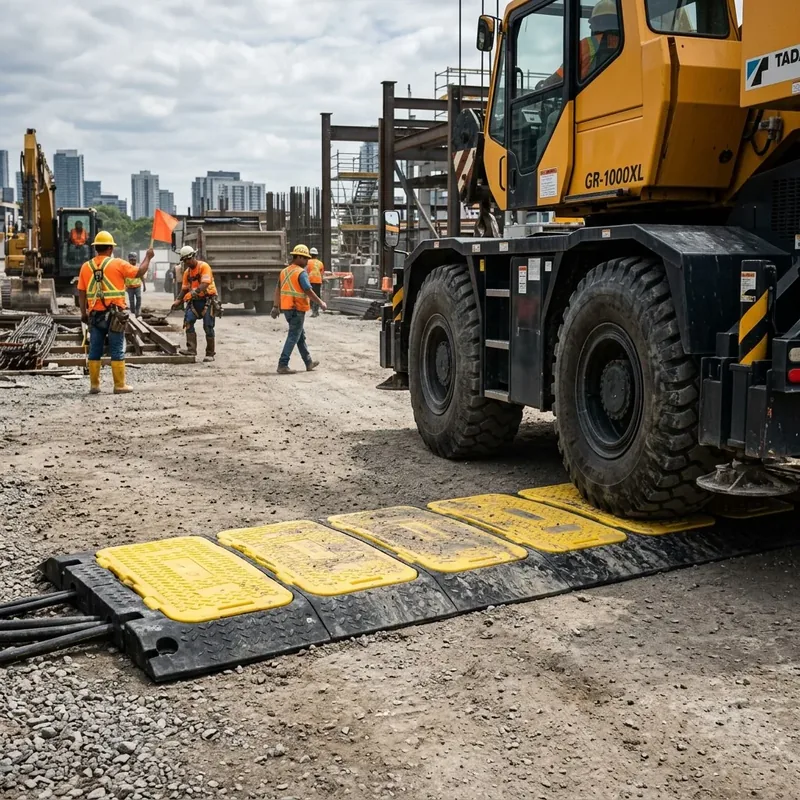
CP-5CH 5-Channel Roadway Protector
900 × 660 × 75 mm · 5 × 42 mm channels · 25-ton static rating · about 22 kg.
View CP-5CH specifications →Run the Four-Question Selection Test
Accessibility: Product Geometry Is Not the Whole Route
The U.S. Access Board treats a cable protector across an accessible route as a change in level. Section 303.4 says changes over ½ inch must be ramped, and section 405.2 limits ramp running slope to 1:12. Section 405.3 limits cross slope to 1:48, while section 403.5.1 requires 36 inches minimum clear width for the walking surface.
That means a compliant installation depends on placement, total width, side slope and surrounding obstructions — not just the label on one module. The CP-3CH gives you a lower-profile starting point, but its published 35 mm rise and 500 mm total width do not by themselves prove a 1:12 side slope. Request the measured side-profile drawing before specifying it. The CP-5CH needs a separately designed accessible crossing wherever the public route also crosses the cable run.
Regulatory source: U.S. Access Board, 2010 ADA Standards: Chapter 3, section 303 and Chapter 4, sections 403.5.1 and 405. Always confirm temporary-event permits and local enforcement requirements.
Calculate Quantity by Crossing Width
Both models are 900 mm long in the direction of the cable run. Divide the required crossing width by 0.9 m and round up. A 5.4 m crossing needs 6 modules; an 8 m crossing needs 9 modules because 8 ÷ 0.9 = 8.89.
| Required crossing width | Modules in one row | Order note |
|---|---|---|
| 3.6 m | 4 | Add spare modules for damaged lids or layout changes |
| 5.4 m | 6 | Confirm whether edge/end pieces add usable width |
| 8.0 m | 9 | Round up; never leave an exposed cable gap |
| 10.8 m | 12 | Check pallet count and handling weight |
RFQ Checklist Before You Ask for Price
- Largest cable outside diameter in millimetres.
- Number of services that must stay separated.
- Heaviest vehicle and expected wheel or axle load.
- Crossing width and total number of crossing points.
- Indoor, outdoor, wet, oily or cold-weather environment.
- Whether the route is used by the public, workers only or vehicles only.
- Required colours, logo, packaging and destination country.
The MOQ for both current models is 20 pieces, so mixed-model planning can be useful when a project has a people-first entrance crossing and a separate heavy-vehicle service crossing. Ask the factory to confirm whether mixed models can be combined in the same production order and shipment.
Frequently Asked Questions
Is a 5-channel cable protector automatically ADA compliant?
No. The standard 5-channel roadway unit is 75 mm high and is designed for heavy vehicles. An accessible route must independently satisfy the applicable ADA change-in-level, ramp slope, cross-slope and clear-width requirements. Optional end ramps do not by themselves certify the whole installation.
What is the largest cable diameter each model accepts?
The CP-3CH accepts cables up to 32 mm in each of three channels. The CP-5CH accepts cables up to 42 mm in each of five channels. Measure the outside diameter of the largest single cable or bundle before ordering.
Which model is better for forklifts and trucks?
The CP-5CH is the vehicle-focused choice: it carries a 25-ton static rating per unit and uses a heavier rubber body. The CP-3CH carries a 10-ton static rating and is intended for pedestrian, cart and light-vehicle routes.
Which model is easier to move between events?
The CP-3CH weighs about 11 kg per 900 mm module, compared with about 22 kg for the CP-5CH. Crews that reset a walkway frequently will normally find the 3-channel model easier to handle.
Can both models separate power and data cables?
Yes. The CP-3CH provides three separate channels, typically power, AV/data and spare/control. The CP-5CH provides five channels for larger mixed services such as power, control, data, audio and a spare run.
What are the current MOQ and production lead times?
Both product pages currently list an MOQ of 20 pieces. The CP-3CH lists 18 days for MOQ production, while the CP-5CH lists 20 days. Confirm the final schedule in the quotation because custom colours, packaging and order volume can change it.
Send one cable schedule, get the right model mix
Tell us the largest cable OD, service count, crossing width, heaviest vehicle and destination country. We will return the module count, model split and packing plan.
Send the cable-protector RFQ →