What Is an ADA-Compliant Cable Protector? Full Buyer's Guide
Every US event operator, trade show organizer, film crew and commercial facility manager needs to know this — because getting it wrong isn't just a spec problem, it's a federal lawsuit exposure. Here's what "ADA-compliant" actually means for the cable protector you're about to order.
The Rule in One Sentence
A cable protector placed across an accessible route is a change in level, and the 2010 ADA Standards give you exactly three options depending on how tall it is: under ¼ in you may leave it vertical, ¼–½ in it must be beveled no steeper than 1:2, and anything over ½ in must be a ramp at 1:12 or gentler. Because virtually every cable protector on the market is taller than ½ in, in practice the 1:12 ramp rule is the one that applies to you.
The Exact Thresholds, Quoted
These are the operative clauses. They are short, and worth reading in the original because most vendor marketing paraphrases them incorrectly:
| Clause | What it says | What it means for a cable ramp |
|---|---|---|
| 303.2 | "Changes in level of ¼ inch (6.4 mm) high maximum shall be permitted to be vertical." | A low-profile cover under ¼ in needs no ramp at all |
| 303.3 | "Changes in level between ¼ inch (6.4 mm) high minimum and ½ inch (13 mm) high maximum shall be beveled with a slope not steeper than 1:2." | Thin drop-over covers must have a 2:1 bevel |
| 303.4 | "Changes in level greater than ½ inch (13 mm) high shall be ramped, and shall comply with 405 or 406." | Every normal cable protector lands here |
| 405.2 | "Ramp runs shall have a running slope not steeper than 1:12." | The 1:12 figure everyone quotes |
| 405.3 | "Cross slope of ramp runs shall not be steeper than 1:48." | The ramp must not tilt sideways — matters on cambered roads |
| 403.5.1 | "The clear width of walking surfaces shall be 36 inches (915 mm) minimum." | Your crossing must be at least 36 in wide |
Source: 2010 ADA Standards for Accessible Design, Chapter 3 (Building Blocks) and Chapter 4 (Accessible Routes), as published by the US Access Board.
The Anatomy of an ADA-Compliant Cable Ramp
Four features distinguish an ADA-compliant unit from a plain "cable cover":
- Slope ratio 1:12 or gentler on both leading edges (not just one)
- Cross slope 1:48 or flatter, so the ramp does not tip a chair sideways
- Contrasting color for visual detection — typically bright yellow lid on black body
- Stable, firm and slip-resistant surface, the wording used in clause 302.1, so wet wheels don't skid
All four boxes must be checked. A yellow lid alone doesn't make it ADA compliant.
Channel Count — What Fits
Cable channel sizing varies by product line. Common channel diameters:
| Channel size | Cable types that fit | Typical use |
|---|---|---|
| 25 mm | Cat6, audio XLR, thin AC extension | Corporate events, AV crossovers |
| 32 mm | SDI video, medium AC, DMX bundles | Trade shows, expos, film shoots |
| 40 mm | Heavy AC (14 AWG), thick data bundles | Outdoor concerts, industrial temp power |
| 50 mm+ | Hydraulic hose, water/air lines, thick cables | Construction sites, roadway crossings |
How Many Channels Do You Need?
Count your cables plus 30% headroom for future runs. A typical 3-channel ramp fits:
- Channel 1: AV/data (SDI video)
- Channel 2: AC power
- Channel 3: control/DMX/spare
For film shoots and larger events, 5-channel is the workhorse. For most trade-show and expo booths, 3-channel is right.
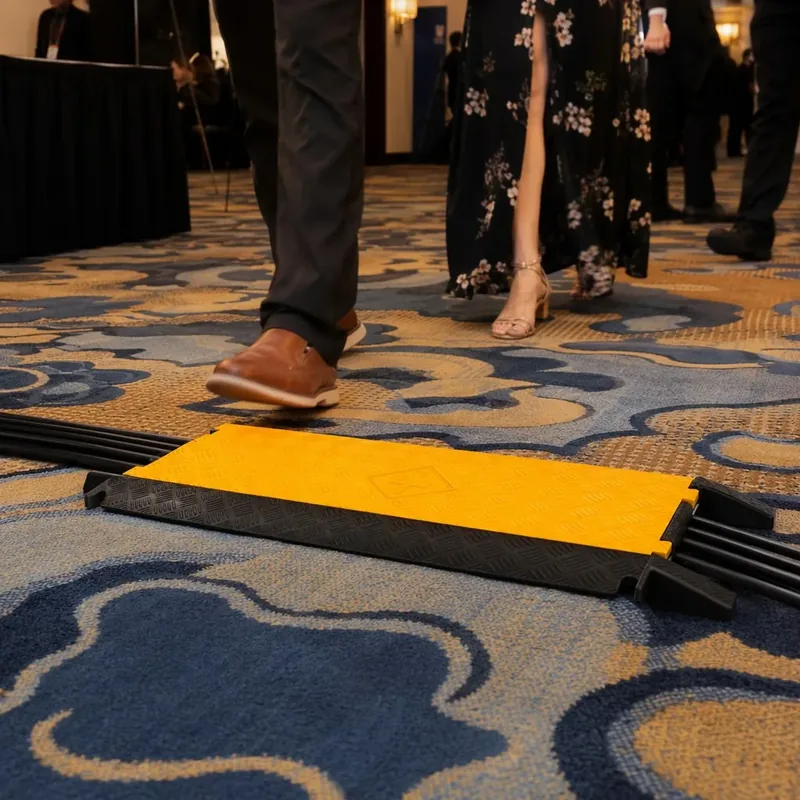
3-Channel ADA Cable Protector Ramp
1:12 compliant slope · 3 channels for AV, power and data · hinged lid · modular interlocking ends.
View specifications & request a quote →Indoor vs Outdoor — Different Products
Two very different use cases:
- Indoor / pedestrian only: ADA slope + light-duty rubber. Our ADA-compliant 3-channel cable protector fits this — pedestrians, carts, wheelchairs, no vehicles.
- Outdoor / vehicle crossing: Reinforced 5-channel rubber that supports truck loads (up to 22 tons per axle). ADA slope still required if pedestrians share the crossing. Our 5-channel roadway cable protector fits this scenario.
Drop-Over Cable Protectors vs ADA Cable Ramps
These two get used interchangeably in product listings, and they are not the same thing. The distinction decides whether you pass an inspection.
| Drop-over cable cover | ADA cable ramp | |
|---|---|---|
| Edge geometry | Near-vertical or lightly rounded | Sloped run, 1:12 or gentler |
| Typical footprint | Barely wider than the cable | 24 in of ramp per inch of rise |
| Fits which clause | 303.2 / 303.3 only if under ½ in tall | 303.4 + 405 |
| Wheelchair crossing | Wheels catch on the lip | Rolls over continuously |
| Honest use case | Back-of-house, staff-only areas | Any public accessible route |
A drop-over cover is not automatically illegal. It is only a problem when it sits on an accessible route — the path the public actually uses to get somewhere. Put it behind the barricade in a cable alley and nobody cares. Put it across the entrance walkway to your expo hall and you have created a barrier.
Using a Cable Protector on a Public Sidewalk
This is the highest-risk placement, and the one people ask about most. A city sidewalk is a public right of way. Running a cable protector across it usually means:
- 36 inches of clear width must survive. Clause 403.5.1 sets the minimum clear width of a walking surface at 36 in. If your ramp is only 34 in wide and the rest of the sidewalk is blocked by your equipment, the route fails — even if the ramp itself is perfectly sloped.
- Cross slope still applies. Sidewalks are built with drainage camber. Lay a ramp on a 2° cambered slab and the cross slope can exceed the 1:48 limit in clause 405.3 without you touching anything.
- You likely need a permit. Most US municipalities treat a sidewalk cable crossing as a temporary right-of-way obstruction requiring a permit from the public works or transportation department. The permit conditions frequently restate the ADA requirements, which is how a spec problem becomes an enforcement problem.
- Both directions of travel must work. A ramp with a compliant approach on one side and a blunt edge on the other is a trap for anyone travelling the other way.
What About the Corners?
Cables rarely travel in a straight line. You need 90° corner pieces plus T-junction pieces for any complex layout. When quoting, ask specifically:
- How many straight modules?
- How many 45° or 90° corners?
- How many end caps (with ADA slope)?
Miss the corner pieces and you'll have cables poking out of the ends — dangerous and non-compliant.
Certifications to Ask For
Reputable manufacturers can supply:
- ADA compliance statement — factory declaration of 1:12 slope
- Load rating test report — for outdoor units crossed by vehicles
- RoHS / REACH — for material safety
- Fire retardant certificate — required for indoor event venues in most US states (UL 94 V-0 minimum)
Realistic Pricing (Factory-Direct from China)
Ballpark FOB pricing for our ADA-compliant units:
- 3-channel indoor ADA (900 mm long): $13.99-15.49 per unit at MOQ 20 pcs, volume pricing from 500 pcs
- 5-channel outdoor heavy-duty (900 mm long): $19.49-20.49 per unit at MOQ 200 pcs
- ADA end caps: $8-15 per pair
- 90° corner pieces: $22-35 per unit
Common Mistakes to Avoid
- Ordering "cable covers" and assuming they're ADA compliant — most standard cable covers have vertical edges, not sloped. Always ask.
- Skipping end caps — the module ends are the highest ADA-risk point. End caps aren't optional.
- Under-sizing channels — you'll damage cables trying to jam them in. Measure your largest cable bundle first.
- Ignoring corner pieces — makes the whole run non-compliant.
ADA Compliance Checker
Enter the dimensions of the cable protector you are evaluating. The tool applies the thresholds quoted above from the 2010 ADA Standards and shows which section governs your case.
Frequently Asked Questions
Is there an ADA maximum height for a cable protector?
No. The 2010 ADA Standards do not cap the height of a cable ramp. They cap the slope. Clause 303.4 says anything over ½ in must be ramped in accordance with clause 405, and 405.2 sets that ramp at 1:12 or gentler. A 2-inch-tall protector with 24 inches of ramp on each side complies; a 1-inch protector with a blunt edge does not.
What slope does an ADA cable ramp need?
1:12 or gentler running slope, per clause 405.2, and 1:48 or flatter cross slope, per clause 405.3. One inch of rise needs at least twelve inches of ramp length.
Can I use a drop-over cable protector on an accessible route?
Only if the total change in level is ½ in or less and it is beveled no steeper than 1:2, per clause 303.3. Above ½ in it must be a proper ramp. Most drop-over covers sold for AV work are taller than that, which puts them outside the exception.
Does the ADA apply to a temporary event?
Being temporary does not exempt you. The obligation attaches to whether the public has access to the route, not to how long the installation stays up. A three-day trade show, a weekend festival and a film shoot on a city street are all in scope while the public is present.
How wide does the crossing have to be?
36 inches minimum clear width, per clause 403.5.1. A narrow ramp laid across a wide sidewalk still fails if the remaining passage is obstructed by your other equipment.
Do I need handrails on a cable ramp?
Not at cable-protector heights. Handrails become a requirement for ramp runs with a rise greater than 6 inches. Cable ramps are far below that threshold, so slope, cross slope, width and surface are what you actually have to get right.
Sourcing ADA cable protectors for an event?
Tell us your channel needs, corners, and event date. Free quote in 24 hours + factory sample.
→ WhatsApp Alice for Quote